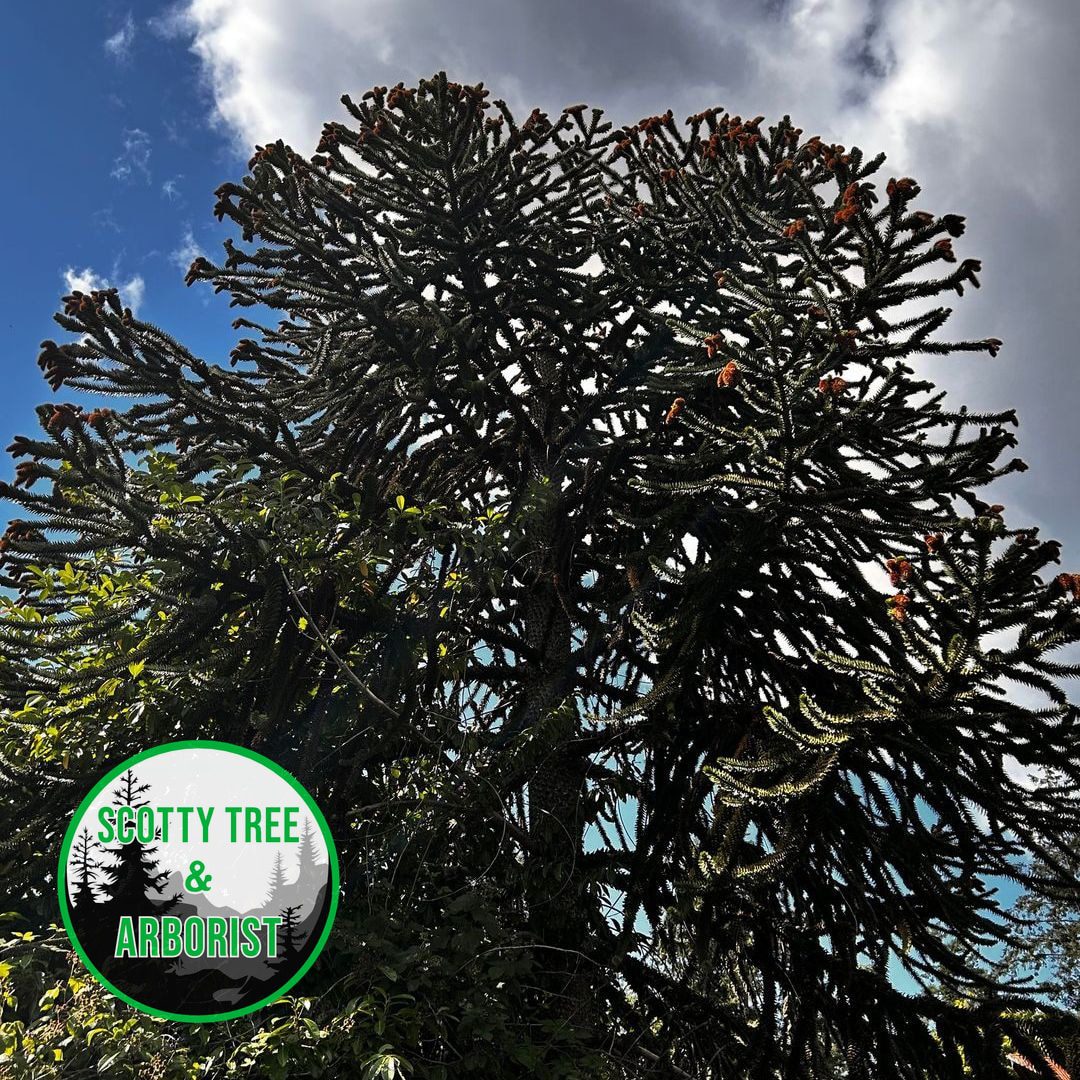
The Monkey Puzzle Tree
Araucaria araucana—known variously as the Monkey Puzzle tree, Chile pine, or pewen—is one of the most unmistakable trees you can plant in a Victoria garden. With stiff, reptilian branches arranged in near-perfect symmetry and razor-sharp, scale-like leaves that spiral tightly around each limb, this ancient evergreen looks like it stepped straight out of the age of dinosaurs. Below you’ll find its history, key features, care requirements, and the benefits it brings to our coastal landscapes.
A Glimpse into the Past
The Monkey Puzzle is native to the volcanic slopes of the south-central Andes in Chile and western Argentina, where it has grown for a very long time and can live well beyond 1,000 years. It is the national tree of Chile and holds deep cultural significance for the Indigenous Mapuche and Pehuenche peoples, who have long harvested its large, nutritious seeds (piñones) as a staple food and honour the tree in seasonal gathering festivals.
Its odd English name comes from Victorian-era Britain around 1850, when the species was still a garden rarity. Admiring a young specimen in Cornwall, one onlooker reportedly quipped that climbing it “would puzzle a monkey”—and the name stuck.
A Botanical Marvel: Distinctive Features
Height & Spread
- Height: 30 – 40 m (98 – 131 ft) at maturity in ideal conditions.
- Trunk Diameter: 1 – 1.5 m (3.3 – 4.9 ft).
- Form: Broadly conical when young, developing the iconic domed, umbrella-like crown with age.
Bark Characteristics
- Thick, wrinkled, grey-brown bark up to 15 cm deep.
- The heavy bark is thought to be an adaptation that helps the tree survive wildfire.
Leaf Description
- Thick, tough, triangular scale-like leaves, 3 – 4 cm long, with sharp edges and points.
- Densely cover the branches, and each leaf can remain alive and attached for up to 24 years.
Cones & Seeds
- Usually dioecious—male and female cones typically grow on separate trees.
- Female (seed) cones are globe-shaped, 12 – 20 cm across, and hold around 200 seeds.
- Cones mature about 18 months after pollination and break apart to release edible, nut-like seeds.
Monkey Puzzle in Victoria, B.C.
Greater Victoria’s mild, wet, temperate coastal climate suits the Monkey Puzzle better than almost anywhere else in North America. It is by far the hardiest member of its genus, tolerating temperatures down to roughly −20 °C (−4 °F), and it thrives in oceanic climates with plentiful rainfall. It prefers well-drained, slightly acidic soil and appreciates coastal conditions—it even tolerates salt spray. One caution for urban gardeners: it does not tolerate air pollution well.
Planting & Care Guide
1. Choosing the Right Location
Pick a spot with full sun, well-drained soil, and plenty of room—remember this tree can eventually reach 30 m or more and needs space to develop its striking silhouette. Avoid low, soggy sites.
2. Planting Techniques
- Transplant while young; large specimens resent being moved.
- Dig a hole about twice the width of the root ball but no deeper.
- Set the root crown level with the surrounding soil and water thoroughly.
3. Watering & Fertilization
Keep the soil consistently moist (never waterlogged) during the first few years while roots establish. Mature trees are considerably more self-sufficient.
4. Pruning
Prune minimally—only to remove dead or damaged wood—and mind those spiny leaves, which are genuinely sharp. Wear gloves and eye protection.
Environmental Benefits
- Wildlife Value: In its native range, seeds feed rodents and the austral parakeet, which help disperse them. In gardens, the tree provides year-round evergreen structure.
- Carbon Sequestration & Air Purification: Like all trees, it captures CO₂ and helps clean the air.
- Living Heritage: As a member of an ancient conifer lineage, a mature Monkey Puzzle is a genuine landscape landmark and conversation piece.
Conservation & Stewardship
The Monkey Puzzle is listed as Endangered by the IUCN (upgraded from Vulnerable in 2013), and it is protected under CITES Appendix I, which prohibits commercial trade in wild-sourced specimens. In its homeland, logging (banned in Chile since 1990), wildfire, overgrazing, invasive species, and heavy seed harvesting have all reduced wild populations. Growing nursery-propagated specimens in gardens like ours is one small way this remarkable species is being kept thriving far from home.
Quick Reference
Common Names
Monkey Puzzle, Chile Pine, Pewen, Pehuén, Piñonero.
Scientific Name
Araucaria araucana
Ideal Site Conditions
- Full sun
- Well-drained, slightly acidic soil
- Ample space and cool, moist oceanic climate
Uses
Ornamental
Prized worldwide as a dramatic specimen tree for its symmetrical, prehistoric form.
Food
The large seeds are edible—similar to oversized pine nuts—and remain an important traditional food in Chile and Argentina.
Timber
Historically valued for its long, straight, decay-resistant trunk, though its wood is now rarely used due to the tree’s protected status.
Sources & Further Reading
- Wikipedia – Araucaria araucana
- IUCN Red List – Monkey Puzzle
- Kew Royal Botanic Gardens – Araucaria araucana
- CITES – Appendices
- Global Trees Campaign – Monkey Puzzle
Need Help with Your Monkey Puzzle?
For expert advice or professional tree services in Victoria, contact Victoria Trees today. Call or text Scott at 250-220-9298, or tap the button below.